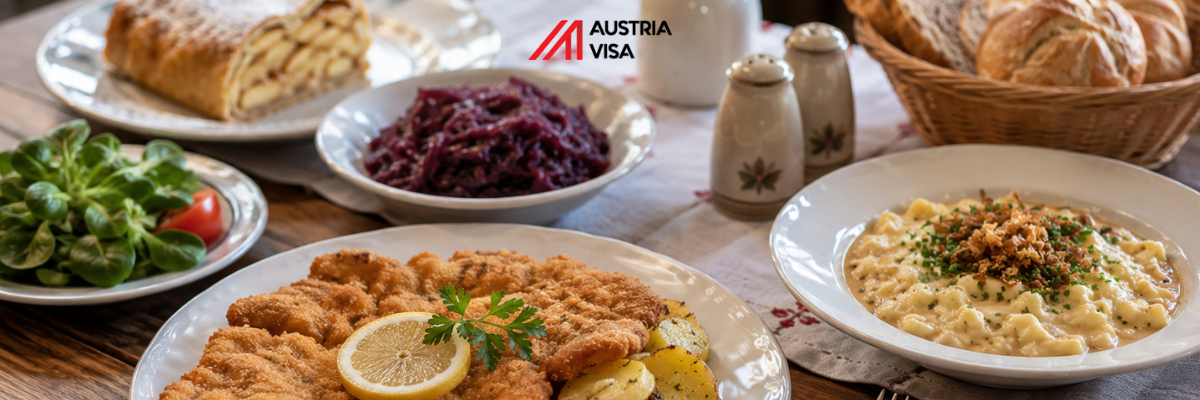
Austrian food is one of Central Europe’s most distinctive culinary traditions. In fact, it was built on centuries of Habsburg imperial cooking and the varied produce of nine alpine and lowland states.
So, the food in Austria changes dramatically from one region to another. In Vienna, a lunch will mean relishing crisp veal schnitzel in a century-old tavern. A few hours west in the Alps, the menus tend to change towards melted cheese, smoked meats and dumplings which are perfect for the cold weather.
UK travellers planning to go on a food escapade in Austria can reach Vienna in roughly 2 hours and 20 minutes by direct flight from London Heathrow or Gatwick, and visa-required passport holders in the UK need an Austria Schengen Visa from UK to visit Austria.
What follows covers the essential dishes, the places worth knowing, and the customs that shape how Austrians eat.
| Category | Quick Info |
| Cuisine Type | Central European, shaped by Habsburg imperial history and Hungarian, Italian, and Bohemian culinary influences |
| Culinary Heritage | Over six centuries of cooking tradition rooted in Vienna’s role as the Habsburg imperial capital |
| Must-Try Savoury Dishes | Wiener Schnitzel, Tafelspitz, Gulasch, Frittatensuppe, Speckknödel, Käsekrainer |
| Signature Desserts | Sachertorte (since 1832), apple strudel (Apfelstrudel), Kaiserschmarrn, Germknödel |
| Typical Meal Cost | EUR 12–24 for a main at a mid-range Beisl; EUR 5.50 – 6.50 at a Würstelstand kiosk |
| Coffee Culture | UNESCO-recognised Kaffeehaus tradition; sit as long as you like on one order; complimentary water always served |
| Best Food Market | Naschmarkt, Vienna — 1.5 km along the Wienzeile; open Monday to Saturday |
| Regional Highlights | Tyrolean Speckknödel; Styrian pumpkin seed oil (PDO status); Carinthian Kasnudeln |
| Best Wine Tavern Areas | Grinzing, Nussdorf, Heiligenstadt — Heurigen serving own-produced wine with cold buffet |
| Tipping Custom | State your rounded total to the server directly; 5–10% is the norm; do not leave cash on the table |
| Vegetarian Availability | Good range in central Vienna; more limited in rural Gasthäuser; traditional menus are largely meat-based |
| Currency | Euro (EUR) — card widely accepted in Vienna; cash advisable at Heurigen, markets, and smaller venues |
Austrian cuisine is a layered Central European tradition shaped by over five centuries of Habsburg rule. In fact, the cuisine drew culinary influences from Hungary, Bohemia, and northern Italy into a single imperial capital. That inheritance is visible on any traditional menu in Vienna today:
You will be fascinated to know that Austria is divided into nine federal states, known as Bundesländer. Each carries a distinct food character:
UNESCO (United Nations Educational, Scientific and Cultural Organization) inscribed Viennese coffee house culture on its Intangible Cultural Heritage list in 2011. This places the coffee culture of Austria alongside traditions such as French gastronomy!
That recognition reflects something real: the Viennese Kaffeehaus is not a café chain or a tourist feature. It is a working social institution, and engaging with it is part of eating in Austria properly!
*We will confirm you through email when the appointment will be fixed.
The best Austrian food for a first visit usually includes slow-braised imperial beef dishes and pan-fried veal to clear consommés and hearty alpine stews. Apart from this, there is a celebrated tradition of desserts and pastries of Austira that are as central to the culture as the savoury cooking.
Wiener Schnitzel is Austria’s most recognised dish internationally. If you want to try out authentic Wiener Schnitzel, you should know that the dish uses veal (Kalb), pounded thin, coated in breadcrumbs, and pan-fried in clarified butter until the coating rises slightly from the meat.
Also, it typically arrives with Erdäpfelsalat (a lukewarm potato salad dressed in vinegar and oil) or Preiselbeeren (lingonberry jam).
One distinction worth noting: You might come across “Wiener Schnitzel vom Schwein” or “Schnitzel nach Wiener Art”. Please note that both use pork rather than veal. Both are common on menus; only the veal version carries the original designation under Austrian food law.
It is simmered beef, typically top round or silverside, served with Apfelkren (apple-horseradish sauce) and Schnittlauchsauce (chive sauce).
Tafelspitz is closely associated with the Habsburg court and was reportedly a favourite dish of Emperor Franz Joseph I.
Slower and more considered than schnitzel, Tafelspitz suits a long lunch rather than a quick stop.
Zwiebelrostbraten is a pan-roasted beef sirloin which is topped with crispy fried onions. You will be surprised to know that it is a staple of the Beisl, the informal neighbourhood tavern that serves as the Austrian equivalent of a local pub.
This Austrian dish is a paprika-braised beef stew. It differs from its Hungarian original in having a thicker, smoother sauce with no added vegetables.
Frittatensuppe, a clear beef consommé with thin pancake strips (Frittaten) floating through it. This dish is a standard starter across Austrian restaurants at every price level.
This Austrian dish is essentially a broth with liver dumplings. It appears consistently in traditional Gasthäuser (the plural of Gasthaus, a traditional inn or tavern) outside tourist-heavy areas.
This local dish of Austria is a spiced curd cheese spread made with paprika and caraway seeds. In fact, it is the typical table spread at Heurigen (wine taverns).
Want to relish such incredible food of Austria? Simply apply for Austria visa from UK to get started!
Did you know? The Austrian Food Codex (Österreichisches Lebensmittelbuch) defines “Wiener Schnitzel” as a breaded veal cutlet; pork versions must be labelled separately as “Schnitzel Wiener Art” or “Wiener Schnitzel vom Schwein.”
Austria’s regional food traditions extend well beyond Vienna, with each federal state contributing dishes tied directly to its landscape, agriculture, and climate:
Carinthia (Kärnten) in southern Austria is known for Kasnudeln. These are essentially half-moon pasta parcels filled with potato and fresh mint curd cheese, served with brown butter.
Vorarlberg, the westernmost state, makes Käsespätzle, soft egg noodles baked with local alpine cheese and topped with fried onions. Genuine regional cooking is most reliably found in local Gasthäuser rather than in tourist-facing restaurants near Vienna’s Stephansplatz.
Get this – Steirisches Kürbiskernöl was granted Protected Geographical Indication (PGI) status by the European Union on 2 July 1996.
Austrian desserts are among the country’s most internationally recognised food exports. In fact, its history is tied directly to Vienna’s imperial kitchens and the coffee houses that grew around them from the 17th century onwards. Here are some sweet delicacies of Austria which you should not miss out on:
Sachertorte is a dense chocolate sponge layered with apricot jam and finished with dark chocolate glaze. Franz Sacher created it in Vienna in 1832.
According to BBC, the recipe later became the subject of a nine-year legal dispute between Hotel Sacher and Café Demel, which concluded in 1963 with Hotel Sacher retaining the right to market the “Original Sacher-Torte” or “Original Cake War”.
A slice at Café Sacher Wien costs approximately EUR 9.50 – 11, so make sure to try it out on your visit!
This sweet dish of Austria uses paper-thin pastry wrapped around spiced apple, raisins, and breadcrumbs.
It is usually served warm with Vanillesauce (vanilla sauce) or Schlagobers (whipped cream).
It is widely available across coffee houses and bakeries, with prices typically ranging from EUR 5.50 – 9.50 per serving.
Kaiserschmarrn is a shredded, caramelised pancake dusted with icing sugar and served with Zwetschkenröster (plum compote).
The name of the dish translates roughly as “Emperor’s mess” and is associated in food tradition with Emperor Franz Joseph I.
Expect the portions of this dish to be generous. Also, it is common in both city restaurants and alpine ski huts, making it one of the more accessible introductions to Austrian desserts.
This Austrian delicacy is a steamed yeast dumpling filled with plum jam and covered in poppy seed butter. You will come across these mainly in winter and on mountain menus — worth ordering if the timing and setting align.
Viennese coffee house culture operates on a single foundational rule:
Order one coffee, take a seat, and stay as long as you like. No one will ask you to leave or encourage a second order. A small glass of water arrives alongside every coffee, at no extra charge. The newspaper rack is there to use.
The coffee vocabulary of Austria is specific and worth learning before arriving:
A Melange at a traditional Kaffeehaus typically costs EUR 4.50 – 7
Note: Ordering a flat white (locals do not usually use this term for coffee variants) will be understood in most establishments, but it signals an outsider immediately.
Have you heard? Café Central in Vienna’s Palais Ferstel is housed in a building constructed between 1856 and 1860; the coffee house itself opened in 1876, according to City of Vienna cultural heritage records.
Vienna’s most authentic eating is not found in the tourist-facing restaurants clustered around Stephansplatz. On the contrary, you will find them at the Naschmarkt, in neighbourhood Beisl taverns across the inner districts, and at the Heurigen wine taverns on the city’s northern and western fringes.
For Austrian street food, the Würstelstand (sausage kiosk) is a genuine local fixture rather than a tourist shortcut. Käsekrainer, a pork sausage with melted cheese pockets, is the standard order and typically costs EUR 5.50 – 6.50 with bread.
In case you didn’t know –Vienna’s Naschmarkt traces its origins to the 16th century, when milk in wooden pails or buckets and produce were sold outside the city walls.
Austrian dining follows a set of customs that differ from informal British eating habits, and knowing them in advance makes the experience considerably more comfortable:
On entering a traditional Gasthaus or Beisl, a brief “Grüß Gott” (a standard regional greeting, broadly equivalent to “good day” across Austria) or “Guten Tag” is expected.
At shared tables in smaller restaurants, a nod to fellow diners is the norm rather than the exception.
Tipping in the Austrian restaurants follows a specific method. A tip of 5–10% is customary but is not left on the table after paying.
State the total you wish to pay when settling the bill: “Machen Sie 22, bitte” means “Make it 22, please.” The server takes the payment and returns no change.
This is consistent practice across traditional Austrian restaurants and is the expected approach.
Bread brought to the table in sit-down restaurants is not always complimentary. Many charge per piece or per portion.
Confirming before eating avoids a small but unnecessary surprise on the bill.
Lunch (Mittagessen) remains the main meal of the day for most Austrians, typically served between noon and 14:00.
A Mittagsmenü (set lunch menu) at a neighbourhood restaurant typically represents excellent value, often EUR 10.50 – 15.50 for a main course.
Tourist restaurants in central Vienna frequently invert this pattern, but a short walk from the first district makes the local rhythm much easier to find.
“Sarah Malik from London had been planning her Vienna trip for months. Everything was booked — flights, hotels, itinerary. Then she tried to secure an Austria visa appointment and found every slot was taken. Weeks were passing with no availability, and her travel date was approaching.”
“We helped her secure a fast-track appointment within two days.”
“I had no idea how fast these slots get booked. I had been refreshing the booking page every single day for two weeks. That is why I reached out to Austria Visas and they sorted it in two days. I could not have managed without them.”
Did you know? Vienna’s drinking water travels more than 120 kilometres from protected alpine spring regions in Lower Austria and Styria through gravity-fed pipelines operated by Wiener Wasser.
Austrian food tells a more interesting story than most visitors usually expect. In fact, you can eat imperial court dishes for lunch. Later, you can try out the cheese-heavy mountain food by dinner. Few European cuisines have the ability to shift your mood that quickly.
If you are planning a trip and need your Austria visa appointment from UK sorted quickly, then consider applying through a trusted partner like AUSTRIA VISAS. We help travellers like you obtain fast-track appointments which help you to quickly secure the Austria visa.
So, the final practical advice to relish Austrian food: find a neighbourhood Beisl, spend an evening at a Heuriger in Grinzing, and visit the Naschmarkt on a Saturday morning. This will allow you to experience Austrian cuisine at its very best.
Wiener Schnitzel is Austria’s most internationally recognised dish. It is served across Austrian restaurants from basic Beisl taverns to more formal dining rooms.
First-time visitors to Vienna should try Wiener Schnitzel, Tafelspitz, Sachertorte, Apfelstrudel, and Kaiserschmarrn to cover the range of dishes most central to Viennese food culture.
A Heuriger is a traditional Austrian wine tavern, legally permitted to sell only wine produced on its own premises. You will typically find these on Vienna’s outskirts in areas such as Grinzing, Nussdorf, and Heiligenstadt. A pine branch (Buschen) hung above the entrance indicates the tavern is open.

Austria visa and Schengen Visa Services

Relentless 15+ years of Visa processing experience

Express Austrian visa UK Services

Round the clock personalized Support from our Experts

Smooth and Hassle-Free Austria Visa Application UK

Assured Data Safety and Confidentiality